Επιλογη φακου.
Στην εξαιρετικη εκδοση της Canon “EF Lens Work III” διαβαζει κανεις τα εξης:
"MTF (modulation transfer function) is a lens performance evaluation method used to determine the contrast reproduction ratio or sharpness of a lens. When evaluating the electrical characteristics of audio equipment, one important measure of performance is frequency response. In this case, where the source sound is recorded through a microphone and then played back through the speakers frequency response indicates the fidelity of the reproduced sound with respect to the source sound. If the reproduced sound is very close to the source sound the equipment is classified as Hi-Fi (high-fidelity).
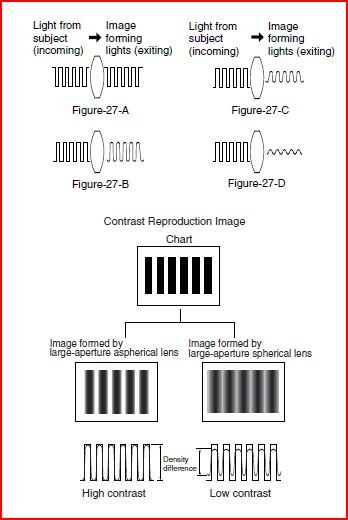
By thinking of the optical system of a lens as a “system for transmitting optical signals” in the same way as an audio system transmits electrical signals, it is possible to find out how accurately optical signals are transmitted as long as the frequency response of the optical system can be measured. In an optical system the equivalent of frequency is “special frequency”, which indicates how many patterns, or cycles, of a certain sine density are present in a 1mm width. Accordingly, the unit of spatial frequency is lines per mm. Figure 27-A shows the MTF characteristics of an ideal “Hi-Fi” lens for a certain special frequency, with the output equal to the input.
A lens of this type is said to provide a contrast of 1:1. However since actual lenses contain residual aberration, actual contrast ratios are always less than 1:1. As the “special frequency” increases (i.e. as the black-and-white sine wave pattern becomes finer or more dense) the contrast decreases as shown in fig.27-D until finally becoming gray with no distinction between black-and-white (no contrast, 1:0) at the special frequency limit. Illustrating this phenomenon in graph form…"
...και εδω υπεισερχεται η αξιολογηση των εκαστοτε φακων με τα γνωστα διαγραμματα MTF, οπου για δυο τυπικες «συχνοτητες» των 10γραμμων/mm και 30γραμμων/mm ελεγχεται η ευκρινεια (resolution) και η αντιθεση (κοντραστ) απ’το κεντρο της εικονας προς τα εξω.
Στη γκαμα φακων του ιδιου κατασκευαστη τα διαγραμματα MTF ειναι απολυτως συγκρισιμα, π.χ. παλια και νεα εκδοση Canon EF70-200/2.8L IS USM: http://www.the-digital-picture.com/Reviews/Canon-EF-70-200mm-f-2.8-L-IS-II-USM-Lens-Review.aspx
Στην εξαιρετικη εκδοση της Canon “EF Lens Work III” διαβαζει κανεις τα εξης:
"MTF (modulation transfer function) is a lens performance evaluation method used to determine the contrast reproduction ratio or sharpness of a lens. When evaluating the electrical characteristics of audio equipment, one important measure of performance is frequency response. In this case, where the source sound is recorded through a microphone and then played back through the speakers frequency response indicates the fidelity of the reproduced sound with respect to the source sound. If the reproduced sound is very close to the source sound the equipment is classified as Hi-Fi (high-fidelity).
By thinking of the optical system of a lens as a “system for transmitting optical signals” in the same way as an audio system transmits electrical signals, it is possible to find out how accurately optical signals are transmitted as long as the frequency response of the optical system can be measured. In an optical system the equivalent of frequency is “special frequency”, which indicates how many patterns, or cycles, of a certain sine density are present in a 1mm width. Accordingly, the unit of spatial frequency is lines per mm. Figure 27-A shows the MTF characteristics of an ideal “Hi-Fi” lens for a certain special frequency, with the output equal to the input.
A lens of this type is said to provide a contrast of 1:1. However since actual lenses contain residual aberration, actual contrast ratios are always less than 1:1. As the “special frequency” increases (i.e. as the black-and-white sine wave pattern becomes finer or more dense) the contrast decreases as shown in fig.27-D until finally becoming gray with no distinction between black-and-white (no contrast, 1:0) at the special frequency limit. Illustrating this phenomenon in graph form…"
...και εδω υπεισερχεται η αξιολογηση των εκαστοτε φακων με τα γνωστα διαγραμματα MTF, οπου για δυο τυπικες «συχνοτητες» των 10γραμμων/mm και 30γραμμων/mm ελεγχεται η ευκρινεια (resolution) και η αντιθεση (κοντραστ) απ’το κεντρο της εικονας προς τα εξω.
Στη γκαμα φακων του ιδιου κατασκευαστη τα διαγραμματα MTF ειναι απολυτως συγκρισιμα, π.χ. παλια και νεα εκδοση Canon EF70-200/2.8L IS USM: http://www.the-digital-picture.com/Reviews/Canon-EF-70-200mm-f-2.8-L-IS-II-USM-Lens-Review.aspx