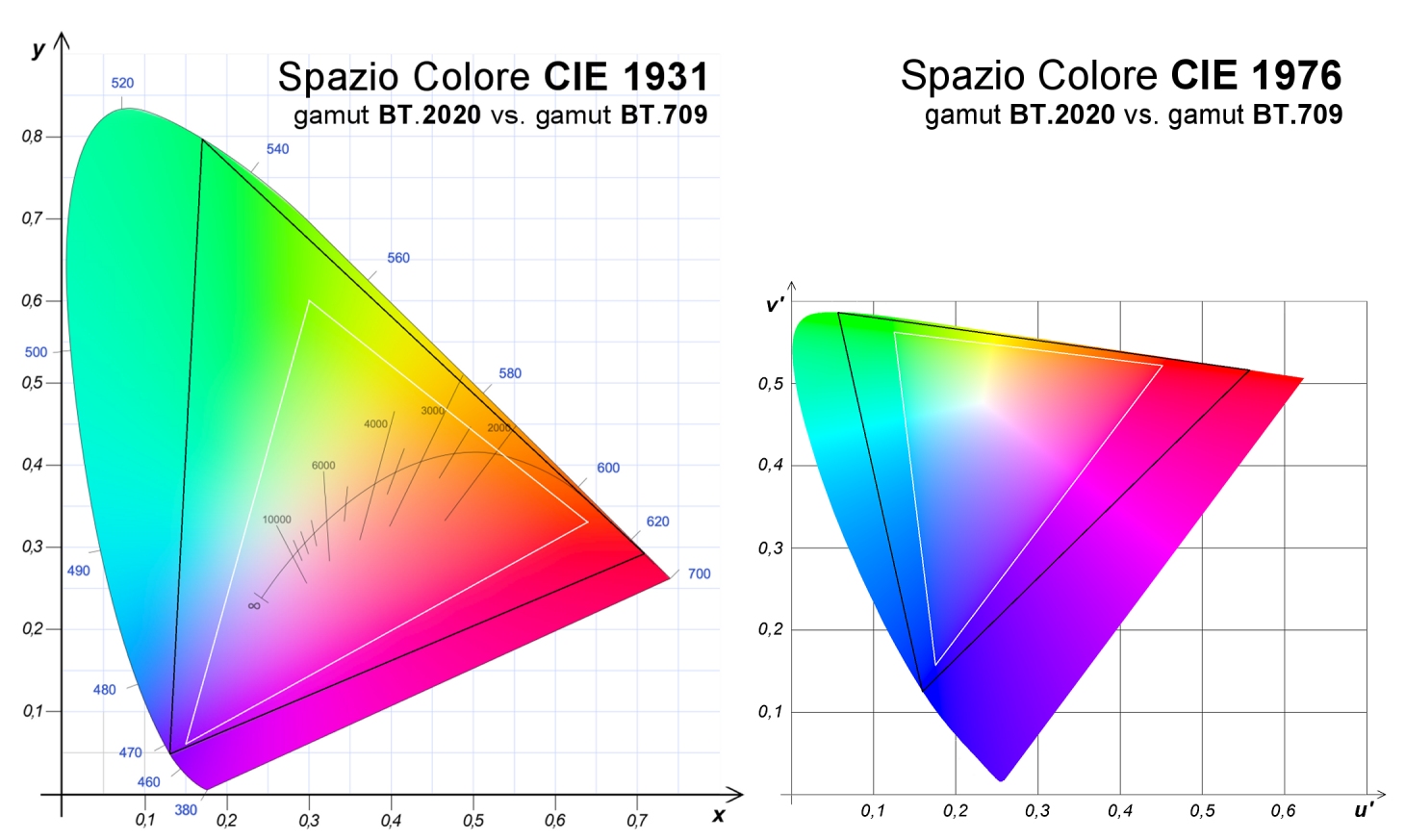
100% del REC BT.2020 ed oltre? Impossibile e inutile: In questo ultimo lustro, prima con i proiettori trilaser RGB e oggi con i TV LCD con retroilluminazione RGB, le fesserie dichiarate...

www.avmagazine.it
The actual color space that a display can display (especially as perceived by the human eye) is not the same as what is typically measured and quoted as “% BT.2020 coverage.”
Here’s why this difference occurs and how exactly it’s measured:
1. How the “visible” color space is measured (the standard method)
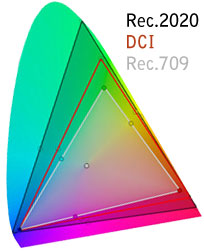
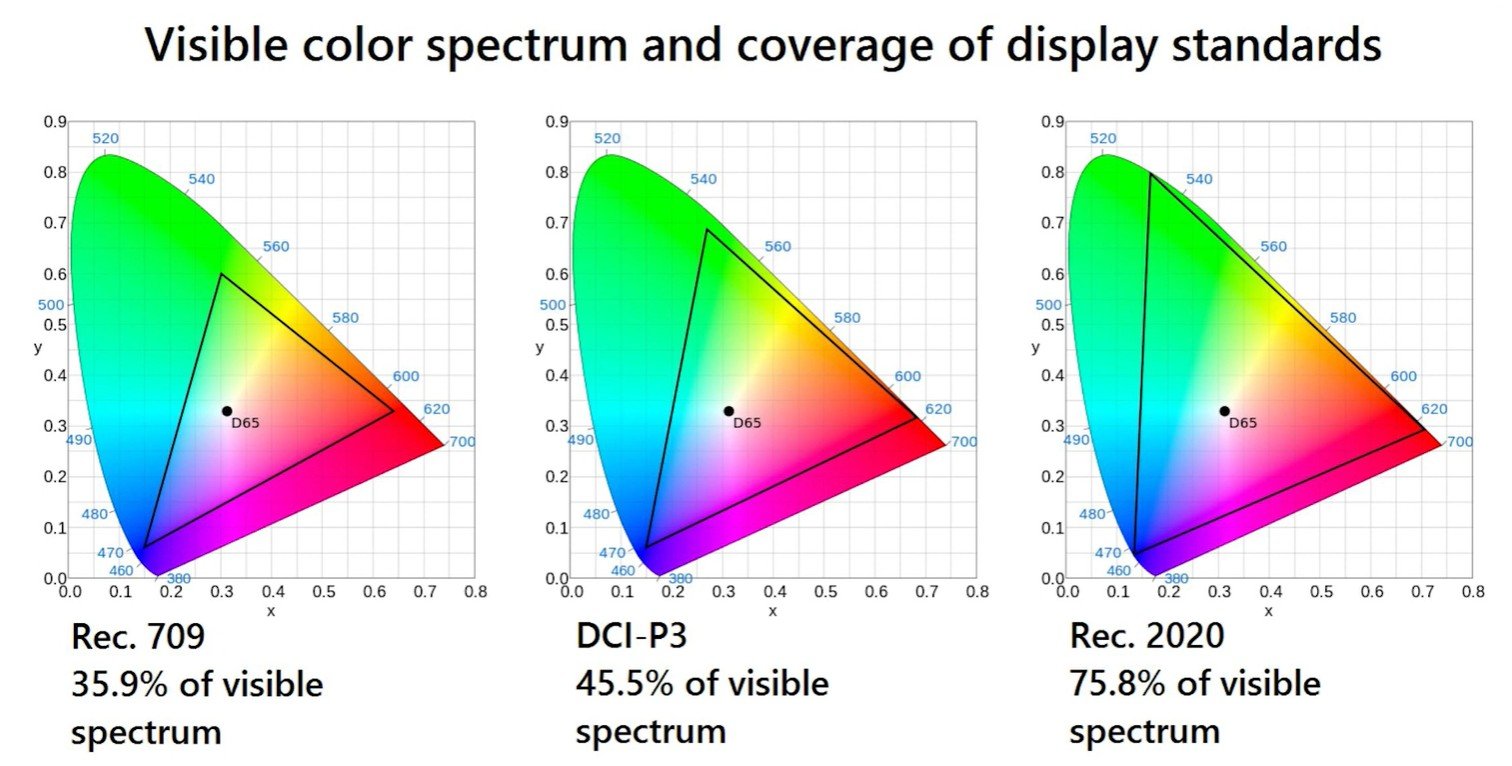
Most reviews (RTINGS, FlatpanelsHD, TechRadar, etc.) measure 2D color gamut — this is a flat triangle in the CIE 1931 xy chromaticity diagram.
The primary colors (primaries: red, green, blue) are measured at a fixed brightness (usually at 100% stimulus, i.e. maximum saturation for that color).
Then, it is calculated what percentage of the area of the BT.2020 triangle the TV triangle covers.
This is easy to measure with a colorimeter or spectroradiometer, which is why everyone does it that way.
The problem: the CIE 1931 xy diagram is not perceptually uniform — equal spacing in the diagram does not mean equally noticeable difference to the eye (especially in the green area it is very “stretched”). Moreover, it is only a 2D cross-section at one specific brightness.
2. The real “visible” color space is 3D (Color Volume)
Human vision perceives color in three dimensions :
Hue
Saturation
Luminance / Brightness
Color Volume is a 3D "bubble" or "pyramid" that shows how many saturated colors the display can display at different brightness levels .
At low brightness (dark scenes) — the color often becomes less saturated (desaturation).
At high brightness, some OLEDs (especially WOLEDs) lose saturation of bright colors (color washout).
Therefore, even if the 2D gamut is 80% BT.2020, the actual color volume can be significantly smaller or larger depending on the technology.
RTINGS and Portrait Displays now show Gamut Rings or 3D color volume precisely to see this difference — it's closer to "real view."
3. Other important reasons for the "measured vs. real view" difference
CIE 1931 vs CIE 1976 u'v' — 1931 is older and less uniform; many manufacturers and reviews still use 1931, which can overestimate or underestimate certain colors.
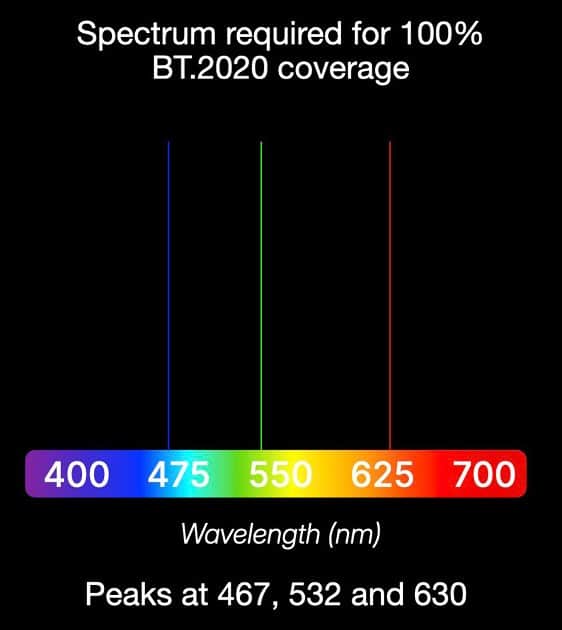
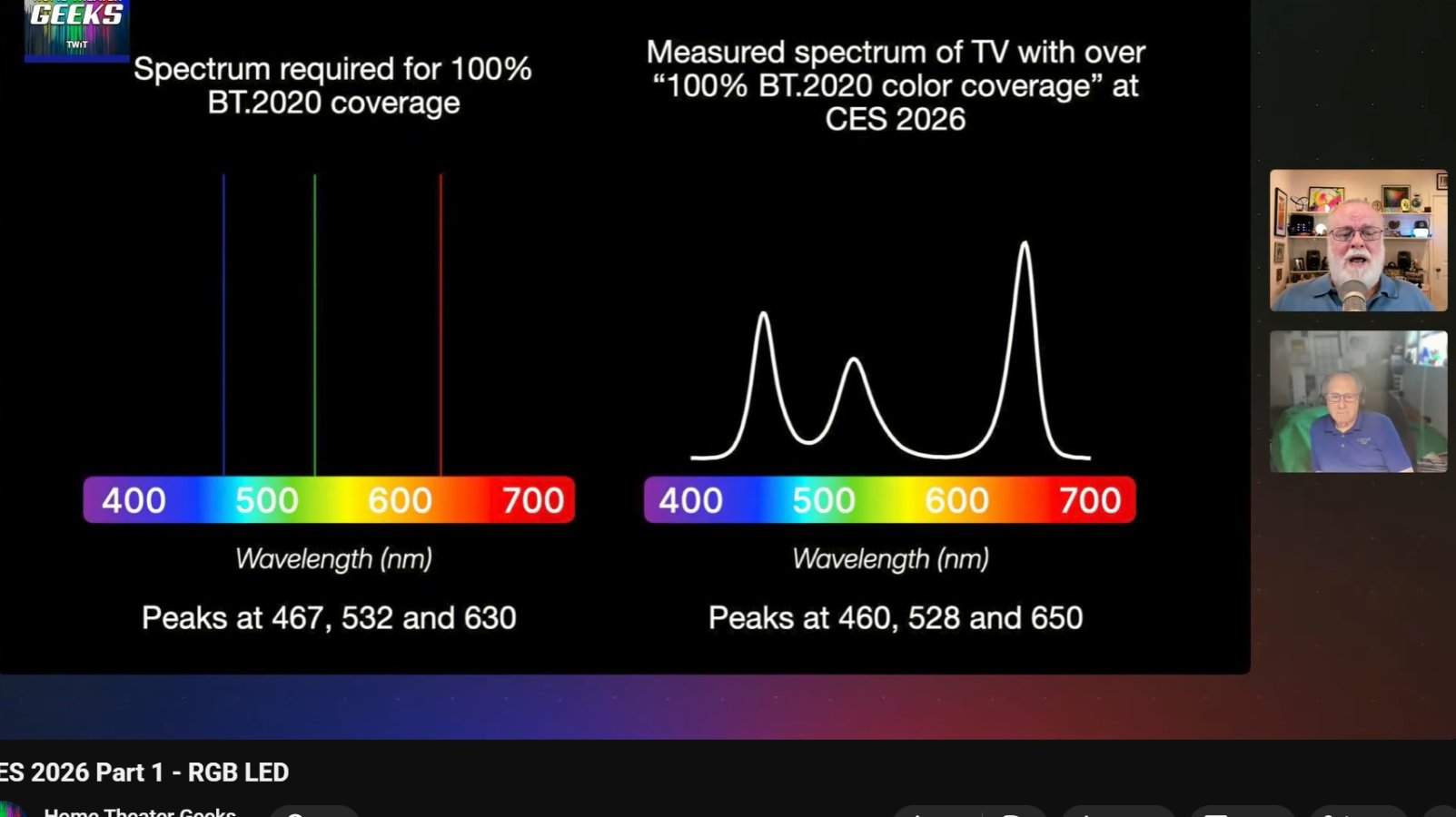
Spectral characteristics — In WOLEDs with color filters, the green color is often broader (less pure), which reduces the actual saturation in real content, even if the primaries look good on paper.
Hyperfluorescent green (which we talked about earlier) — this is where the big leap will happen. The narrower green spectrum will make the actual color volume much closer to the measured 2D gamut, especially at mid and high brightnesses.
Real-world content — There is almost no material that uses full BT.2020. Most HDR is mastered in DCI-P3 (which is smaller than BT.2020). Therefore, even 75–80% BT.2020 often looks “saturated enough” in practice.
Brief summary
Measured % BT.2020 (2D gamut) — often appears more optimistic or pessimistic than reality because it ignores brightness and perception.
What is actually visible depends on the color volume (3D), how well it retains saturation at different brightnesses, and how the eye perceives it (better described with uniform spaces like CAM16-UCS or ICtCp).
With the future 5-stack BGBRG WOLED with hyperfluorescent green, I expect the measured % BT.2020 to jump significantly (towards 85–95%), and the actual color volume to improve even more, because the green will be cleaner and brighter.
If we compare the visible color space with the real color space - as it is in our environment... is there any discrepancy, that is, a percentage in which there is no overlap?
Yes, there isand it is quite large, especially if we compare the "visible color space" of the display (what the reviews measure as % of BT.2020) withthe real colors in our environment(reflected surface colors from nature, objects, skin, food, flowers, etc.).
Here is the exact picture:
1. What is the "real" color space in the real world?
Most real colors that we see every day arereflected(surface colors), not emissive like on a display. They do not cover the entire visible spectrum of the human eye (CIE 1931 or CIE 1976), because physical materials do not reflect light in a random way.
The best approximation for true surface colors isPointer's Gamut(defined by Michael Pointer in 1980 and expanded upon later). This is an irregular "cloud" of true measured colors of natural and artificial objects.
2. How large is the discrepancy (percentage of non-overlap)?
BT.2020 (Rec.2020) covers about 99.9% of the Pointer's Gamut (in the CIE 1931 xy diagram). This means that almost all real surface colors that exist in nature can theoretically be reproduced in BT.2020.
DCI-P3 covers about 85–87% of Pointer's Gamut.
Rec.709 / sRGB covers significantly less — about 70% or less of the actual surface colors.
The other side (divergence):
There is a very small percentage (less than 0.1–1%) of real colors that are outside of BT.2020 — mainly some extremely saturated cyan, green, or blue hues under certain lighting conditions.
BT.2020 does not cover the entire visible spectrum of the human eye (only about 75–76% of all possible chromaticities in CIE 1931). The remaining ~24–25% are colors that the eye can see (e.g. in spectral sources such as lasers or rainbows), but almost do not exist as reflected surface colors in the real world.
In other words:
If the display covers 100% BT.2020 , it can display almost all the colors we encounter in everyday life (very close to "real").
The discrepancy between BT.2020 and the real world is minimal (less than 1% missing real colors).
The bigger discrepancy is between current displays (which rarely go above 80–85% BT.2020 in real life) and the real world — there are many saturated greens, cyans, and some reds missing.
3. Why do we still feel a “difference” between display and reality?
Color Volume : Even if the 2D gamut is large, at high brightness many displays (especially WOLED) desaturate colors. The real world retains saturation at different levels of illumination.
Metamerism and spectrum : Displays use metameric combinations (a mixture of RGB), while real objects have a continuous spectrum. Sometimes a color "appears" different under different lighting.
Optimal Colors : There are theoretical colors (with 100% reflection in a narrow range) that are more saturated than Pointer's Gamut and that no RGB display can fully reproduce.
Summary
BT.2020 is precisely designed to cover almost the entire real world surface color spectrum (99.9% of Pointer's Gamut). The deviation is very small — less than 1%.
The real discrepancy we see in practice comes mainly from the fact that current displays (including the best OLED/QD-OLED) still do not reach full BT.2020 coverage + do not maintain perfect color volume at high brightness.