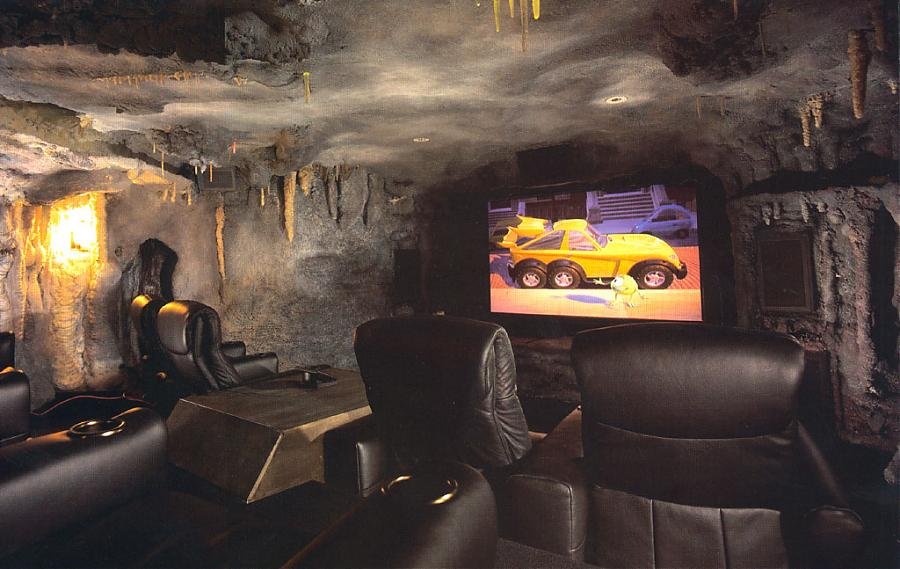
Τι κάνει 1 Τεξανός πολύεκατομμυριούχος για να σκοτώσει τα λεφτά του? Φτιάχνει ένα από τα πιο ακριβά Home Cinema στον κόσμο. Money has no object here. Μια απίστευτη υλοποίηση που κόστισε 3,4 Εκατομμύρια $!!! :blink: Φυσικά δεν θα έλειπαν και τα βραβεία. Το περιοδικό Home Entertainment έδωσε το βραβείο Ιnstallation of the Year 2007
Home Entertainment - Ιnstallation of the Year 2007


I get an idea of what I'm in for before I even set foot inside the house. Huge transformers in a room off the garage hum softly as the electronic systems designer, Kyle Griffith of Texas Integrated Systems, describes the home's power system. "There are three transformers for the house and one for the pool house," he explains. "There are three electrical panels just for the media system and two grounding rods with special clay packed around them to help eliminate electrical noise. We had to upgrade the outside service four times as the job grew"—a fact confirmed when I see that the curbside service box is about three times as large as those of the neighboring homes in this development outside Austin, Texas.

What kind of audio/video system could demand thrice the power that a typical suburban home draws? I soon find out. Griffith leads me up a flight of stairs and opens a pair of huge bronze doors decorated with cast figures of lions. Behind the doors lies one of the most ornate—yet apparently simple—home theaters I have ever seen. Its character lies in the details. "The fabrics are hand-screened and hand-embroidered," interior designer Mark Cravotta points out. "All of the sconces were cast from original antiques. The carpet is handmade in a single piece."
"And all of that gilding you see is 24-karat gold," Griffith adds. "We were all walking around with gold flakes in our hair for a couple of weeks."

The decor quickly fades from my consciousness when Griffith taps the Crestron touchscreen to bring down the lights and fire up the home theater system. A few seconds of King Kong are enough to tell me that this theater is to a typical media room what an F-16 fighter is to a Gulfstream business jet: something in the same basic category, but at the same time totally incomparable. My theater chair shakes violently as brontosauruses stampede across the screen. I look down, wondering if Griffith might have added some sort of tactile transducers to shake the seats; he notices and turns the sound down to explain that the theater hosts an astounding 24 subwoofers. "They're all 12-inchers," he says. "I'd rather use a lot of smaller subs than a few large ones because the smaller ones are quicker and more efficient."

Thanks to its huge complement of CAT/MBX speakers and amplifiers, and to extensive on-site tuning by Griffith and a team of CAT engineers, the system sounds as clean at a deafening volume as a typical home theater system does running at grandmother-pleasing levels. When I play my favorite music DVD—Live Aus Berlin, by German industrial rock band Rammstein—Griffith does not restrain me as I crank up the volume on the Crestron to levels I have never before heard with this DVD. It's an amazing experience. It seems as loud as being right next to the band's PA speakers, yet it sounds as smooth as a great high-end audio system quietly playing Bach's sonatas for solo violin. I can tell that more than a few minutes' exposure to such a high volume would damage my hearing, but the sound is so clean that my ears never hurt. The theater's power is almost dangerously addictive. Yet it sounds just as amazing—although in a completely different way—when I play James Taylor's Live at the Beacon Theater DVD. I have listened to this DVD through hundreds of audio systems, but can recall none that so accurately portray the Beacon's ambience or Taylor's gentle voice.


To each side of the screen lie gorgeous crimson curtains—"The style of the room is based on turn-of-the-century Parisian opera houses," Cravotta notes—that conceal two of the theater's three equipment cabinets. These two cabinets contain only amplifiers: models from Audio Design Associates designed specifically for use in CAT/MBX systems. The choice of crimson is a compromise between the perfect video environment Griffith wanted and the look Cravotta and the client desired. "Kyle needed as little light reflection as possible—he'd have liked to do all black, but that wasn't going to work," Cravotta says. "So we settled on the dark crimson and toned down the wood finish in the theater so it wasn't so shiny. All of the wood, by the way, is finished using a process that takes seven to nine steps, concluding with polish and wax."

Runco MBX-1 Projector
250.000 $

The Runco MBX-1 projector that provides the video images weighs more than 200 pounds and measures nearly 3 feet long. It's essentially a commercial-grade projector, capable of producing images as large as 40 feet wide. Driving this theater's 8-foot-wide screen, the MBX-1 is loafing. Yet it's the projector's many lens options and wide horizontal and vertical offset capability that made this installation possible. Griffith explains, "We didn't want the projector hanging from the ceiling, but there's no way we could put a lift in because the central support beam for the house blocked us. We also couldn't put it way back in the room because the doors are right in the center. We ended up mounting it 42 inches off center. It works, but I wouldn't recommend your readers try it. Pat Bradley from Runco has been here four times to perfect the image."
38 Zones of High-End Audio
The main equipment cabinet, which hides behind another set of curtains in the back right corner, houses the brains of the home theater system, the multiroom audio system, and the home automation system—five racks of gear, all accessible from front and back, and all cooled by 24,000 BTUs of air conditioning. I comment to Griffith that each audio cable is trimmed to the precise length needed, yet none use crimp-on plugs. "We hand-soldered the RCA connectors," he explains. "It took three weeks, but that's what the client [a tech executive whose hobby is high-end car audio] wanted, and what I wanted. We didn't want to use 75-ohm cable [the type that was until recently used for almost all crimp-on plugs] for a job like this."
Besides holding the ADA surround-sound processor, the source devices (including a Kaleidescape DVD server and ReQuest Multimedia audio servers), and the extra amps and digital audio processors required to make the home theater run, this cabinet holds a rack full of interface devices and controllers for the Crestron home automation system, plus nine of ADA's outstanding PTM-6150 six-channel amps for the multiroom audio system. "This multiroom system demands and deserves great amplifiers," Griffith says. "The least expensive speaker in the house is a $2,000 pair of CAT in-walls. When you consider that there are 38 audio zones here, that's quite an investment in speakers."
Raising the Bar
We push the bronze doors open—Cravotta points out that they swing on $6,000 worth of pivots that are similar to those used for bank vaults, and that they took a year to produce—and enter the bar, which seems to take its style cues from a gothic cathedral. The woodwork is overwhelming in its beauty and its intricacy. "This house isn't like anything else out there," Cravotta says. "It's inspired by the old Dark Shadows TV show, the Tim Burton Batman movies, and European castles."
In every room, the elaborate woodwork dominates the look. Each panel and trim piece is finished to match the look of the mid-1800s fireplace in the living room that sits next to the kitchen, below the bar. "The fireplace came from a chateau in France that was being sold off in pieces," Cravotta says. "It's French walnut, but the wood in the rest of the home is American walnut; we had to dye the American walnut yellow before we stained it so it would match. Then after we installed all the wood panels, an artisan went through with an X-acto knife and opened up some joints a little to match the look of the older woodwork better."
The bar overlooks the living room and its arched windows allow a spectacular view of the surrounding hills. My favorite feature of the bar is the pair of CAT/MBX speakers concealed in two columns—an idea CAT president Brian Barr came up with during a mid-construction walk-through. These are essentially the same speakers used in the theater, but configured for stereo music. Griffith says extremely rigid mounting improves the speakers' sound: "The cabinets are made from Avonite, which is like Corian. But the outside of the cabinets is wrapped in high-density fiberboard so we can screw into them. The boxes are glued to the framing members of the house and have custom metal flanges that hold the speakers in with 8-inch lag bolts."
A seat notched out of the hand-carved bar holds a couple of listeners comfortably; cabinets in the bar house the amplifiers, CD players, and other gear necessary to feed the towering speakers. The sound here is as incredible as in the theater, but perhaps even livelier due to the more spacious, less acoustically absorptive surroundings.
"This is my favorite part of the house," Cravotta offers.
"The fact that Mark is a two-channel audio enthusiast made it a lot easier," Griffith adds. "He understood what we were trying to do."
"We started off with Cheers and ended up with this," Cravotta jokes.
Controlling the Castle
As we walk into the living room, Griffith takes me to a large Crestron touchscreen, built into the wall using matching wood trim. I notice right away that the background art for the screens consists of the conceptual sketches for the home's interior design, drawn by Cravotta's mother. And I quickly realize that the graceful sketches belie the screen's powerful control capabilities.
"Of course, you can control the sound and the video with these," Griffith explains. "But you can also control all the lights in the house—it's the equivalent of having 285 light switches in one panel, but a lot easier to use. And you can control the six garage doors. And the six humidifiers that maintain the right environment for the woodwork. And you can control the temperature of the swimming pool and the 30-person spa. You can also access 16 security cameras, and whenever someone drives up, their picture appears on the touchscreens. We even set it up so that the client can redo the TV channels on the touchscreens—even to the point of changing the logos—as his tastes or the channel offerings change."
As Griffith and Cravotta tour me around the rest of the house, I see that despite its size, it contains only four bedrooms. Of course, each one is spectacular in its own way—especially the master suite, which features a Runco flat-panel TV concealed behind a mirror. The billiards room charms with its old English style—and with an original 1879 French painting that rises to reveal a Runco plasma TV. A long stone stairway leads us down to the wine cellar—a real cellar, complete with arched stone doorways and enough storage capacity to satisfy the most hard-core wine enthusiast.
Cravotta points out the details in the woodwork, including dozens of hand-carved reliefs topping the thin columnar panels that join the larger panels. Most of the reliefs depict medieval figures and scenes, but four portray the members of the Beatles—a subtle, whimsical twist that only the most observant guest would notice. "When you think about great houses, most of them developed over hundreds of years," Cravotta explains. "In my research when I was designing the home, I ordered out-of-print books from the late 1800s and early 1900s about old cathedrals. I was inspired by those places. They never repeated carpentry details because so many teams worked on them and each team wanted to put its own stamp on it."
"It is pretty incredible how much went into this four-bedroom house," Griffith comments. "We ended up doing about $3.4 million worth of audio, video, and automation. Lincoln Dickson, the lead installer, practically lived on this site for about five years."
"It's been a dream project," Cravotta says. "The homeowner is so appreciative of fine detail, it allowed us to do things most people wouldn't appreciate or pay for."
Griffith nods and adds, "It takes the right team and the right clients to do a project like this. Fortunately, we had both."
Home Entertainment
KG Theaters
Home Entertainment - Ιnstallation of the Year 2007
I get an idea of what I'm in for before I even set foot inside the house. Huge transformers in a room off the garage hum softly as the electronic systems designer, Kyle Griffith of Texas Integrated Systems, describes the home's power system. "There are three transformers for the house and one for the pool house," he explains. "There are three electrical panels just for the media system and two grounding rods with special clay packed around them to help eliminate electrical noise. We had to upgrade the outside service four times as the job grew"—a fact confirmed when I see that the curbside service box is about three times as large as those of the neighboring homes in this development outside Austin, Texas.
What kind of audio/video system could demand thrice the power that a typical suburban home draws? I soon find out. Griffith leads me up a flight of stairs and opens a pair of huge bronze doors decorated with cast figures of lions. Behind the doors lies one of the most ornate—yet apparently simple—home theaters I have ever seen. Its character lies in the details. "The fabrics are hand-screened and hand-embroidered," interior designer Mark Cravotta points out. "All of the sconces were cast from original antiques. The carpet is handmade in a single piece."
"And all of that gilding you see is 24-karat gold," Griffith adds. "We were all walking around with gold flakes in our hair for a couple of weeks."
The decor quickly fades from my consciousness when Griffith taps the Crestron touchscreen to bring down the lights and fire up the home theater system. A few seconds of King Kong are enough to tell me that this theater is to a typical media room what an F-16 fighter is to a Gulfstream business jet: something in the same basic category, but at the same time totally incomparable. My theater chair shakes violently as brontosauruses stampede across the screen. I look down, wondering if Griffith might have added some sort of tactile transducers to shake the seats; he notices and turns the sound down to explain that the theater hosts an astounding 24 subwoofers. "They're all 12-inchers," he says. "I'd rather use a lot of smaller subs than a few large ones because the smaller ones are quicker and more efficient."
Thanks to its huge complement of CAT/MBX speakers and amplifiers, and to extensive on-site tuning by Griffith and a team of CAT engineers, the system sounds as clean at a deafening volume as a typical home theater system does running at grandmother-pleasing levels. When I play my favorite music DVD—Live Aus Berlin, by German industrial rock band Rammstein—Griffith does not restrain me as I crank up the volume on the Crestron to levels I have never before heard with this DVD. It's an amazing experience. It seems as loud as being right next to the band's PA speakers, yet it sounds as smooth as a great high-end audio system quietly playing Bach's sonatas for solo violin. I can tell that more than a few minutes' exposure to such a high volume would damage my hearing, but the sound is so clean that my ears never hurt. The theater's power is almost dangerously addictive. Yet it sounds just as amazing—although in a completely different way—when I play James Taylor's Live at the Beacon Theater DVD. I have listened to this DVD through hundreds of audio systems, but can recall none that so accurately portray the Beacon's ambience or Taylor's gentle voice.
To each side of the screen lie gorgeous crimson curtains—"The style of the room is based on turn-of-the-century Parisian opera houses," Cravotta notes—that conceal two of the theater's three equipment cabinets. These two cabinets contain only amplifiers: models from Audio Design Associates designed specifically for use in CAT/MBX systems. The choice of crimson is a compromise between the perfect video environment Griffith wanted and the look Cravotta and the client desired. "Kyle needed as little light reflection as possible—he'd have liked to do all black, but that wasn't going to work," Cravotta says. "So we settled on the dark crimson and toned down the wood finish in the theater so it wasn't so shiny. All of the wood, by the way, is finished using a process that takes seven to nine steps, concluding with polish and wax."
Runco MBX-1 Projector
250.000 $
The Runco MBX-1 projector that provides the video images weighs more than 200 pounds and measures nearly 3 feet long. It's essentially a commercial-grade projector, capable of producing images as large as 40 feet wide. Driving this theater's 8-foot-wide screen, the MBX-1 is loafing. Yet it's the projector's many lens options and wide horizontal and vertical offset capability that made this installation possible. Griffith explains, "We didn't want the projector hanging from the ceiling, but there's no way we could put a lift in because the central support beam for the house blocked us. We also couldn't put it way back in the room because the doors are right in the center. We ended up mounting it 42 inches off center. It works, but I wouldn't recommend your readers try it. Pat Bradley from Runco has been here four times to perfect the image."
38 Zones of High-End Audio
The main equipment cabinet, which hides behind another set of curtains in the back right corner, houses the brains of the home theater system, the multiroom audio system, and the home automation system—five racks of gear, all accessible from front and back, and all cooled by 24,000 BTUs of air conditioning. I comment to Griffith that each audio cable is trimmed to the precise length needed, yet none use crimp-on plugs. "We hand-soldered the RCA connectors," he explains. "It took three weeks, but that's what the client [a tech executive whose hobby is high-end car audio] wanted, and what I wanted. We didn't want to use 75-ohm cable [the type that was until recently used for almost all crimp-on plugs] for a job like this."
Besides holding the ADA surround-sound processor, the source devices (including a Kaleidescape DVD server and ReQuest Multimedia audio servers), and the extra amps and digital audio processors required to make the home theater run, this cabinet holds a rack full of interface devices and controllers for the Crestron home automation system, plus nine of ADA's outstanding PTM-6150 six-channel amps for the multiroom audio system. "This multiroom system demands and deserves great amplifiers," Griffith says. "The least expensive speaker in the house is a $2,000 pair of CAT in-walls. When you consider that there are 38 audio zones here, that's quite an investment in speakers."
Raising the Bar
We push the bronze doors open—Cravotta points out that they swing on $6,000 worth of pivots that are similar to those used for bank vaults, and that they took a year to produce—and enter the bar, which seems to take its style cues from a gothic cathedral. The woodwork is overwhelming in its beauty and its intricacy. "This house isn't like anything else out there," Cravotta says. "It's inspired by the old Dark Shadows TV show, the Tim Burton Batman movies, and European castles."
In every room, the elaborate woodwork dominates the look. Each panel and trim piece is finished to match the look of the mid-1800s fireplace in the living room that sits next to the kitchen, below the bar. "The fireplace came from a chateau in France that was being sold off in pieces," Cravotta says. "It's French walnut, but the wood in the rest of the home is American walnut; we had to dye the American walnut yellow before we stained it so it would match. Then after we installed all the wood panels, an artisan went through with an X-acto knife and opened up some joints a little to match the look of the older woodwork better."
The bar overlooks the living room and its arched windows allow a spectacular view of the surrounding hills. My favorite feature of the bar is the pair of CAT/MBX speakers concealed in two columns—an idea CAT president Brian Barr came up with during a mid-construction walk-through. These are essentially the same speakers used in the theater, but configured for stereo music. Griffith says extremely rigid mounting improves the speakers' sound: "The cabinets are made from Avonite, which is like Corian. But the outside of the cabinets is wrapped in high-density fiberboard so we can screw into them. The boxes are glued to the framing members of the house and have custom metal flanges that hold the speakers in with 8-inch lag bolts."
A seat notched out of the hand-carved bar holds a couple of listeners comfortably; cabinets in the bar house the amplifiers, CD players, and other gear necessary to feed the towering speakers. The sound here is as incredible as in the theater, but perhaps even livelier due to the more spacious, less acoustically absorptive surroundings.
"This is my favorite part of the house," Cravotta offers.
"The fact that Mark is a two-channel audio enthusiast made it a lot easier," Griffith adds. "He understood what we were trying to do."
"We started off with Cheers and ended up with this," Cravotta jokes.
Controlling the Castle
As we walk into the living room, Griffith takes me to a large Crestron touchscreen, built into the wall using matching wood trim. I notice right away that the background art for the screens consists of the conceptual sketches for the home's interior design, drawn by Cravotta's mother. And I quickly realize that the graceful sketches belie the screen's powerful control capabilities.
"Of course, you can control the sound and the video with these," Griffith explains. "But you can also control all the lights in the house—it's the equivalent of having 285 light switches in one panel, but a lot easier to use. And you can control the six garage doors. And the six humidifiers that maintain the right environment for the woodwork. And you can control the temperature of the swimming pool and the 30-person spa. You can also access 16 security cameras, and whenever someone drives up, their picture appears on the touchscreens. We even set it up so that the client can redo the TV channels on the touchscreens—even to the point of changing the logos—as his tastes or the channel offerings change."
As Griffith and Cravotta tour me around the rest of the house, I see that despite its size, it contains only four bedrooms. Of course, each one is spectacular in its own way—especially the master suite, which features a Runco flat-panel TV concealed behind a mirror. The billiards room charms with its old English style—and with an original 1879 French painting that rises to reveal a Runco plasma TV. A long stone stairway leads us down to the wine cellar—a real cellar, complete with arched stone doorways and enough storage capacity to satisfy the most hard-core wine enthusiast.
Cravotta points out the details in the woodwork, including dozens of hand-carved reliefs topping the thin columnar panels that join the larger panels. Most of the reliefs depict medieval figures and scenes, but four portray the members of the Beatles—a subtle, whimsical twist that only the most observant guest would notice. "When you think about great houses, most of them developed over hundreds of years," Cravotta explains. "In my research when I was designing the home, I ordered out-of-print books from the late 1800s and early 1900s about old cathedrals. I was inspired by those places. They never repeated carpentry details because so many teams worked on them and each team wanted to put its own stamp on it."
"It is pretty incredible how much went into this four-bedroom house," Griffith comments. "We ended up doing about $3.4 million worth of audio, video, and automation. Lincoln Dickson, the lead installer, practically lived on this site for about five years."
"It's been a dream project," Cravotta says. "The homeowner is so appreciative of fine detail, it allowed us to do things most people wouldn't appreciate or pay for."
Griffith nods and adds, "It takes the right team and the right clients to do a project like this. Fortunately, we had both."
Home Entertainment
KG Theaters