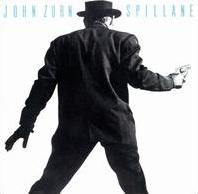
John Zorn's landmark album "Spillane" was recorded 1987.
In the case of Two-Lane Highway, my role is perhaps more akin to that of an organizer, producer, and director. The piece was created to highlight the guitar of perhaps the greatest living bluesman, Albert Collins. I wanted to put him in a setting that was sometimes comfy, sometimes very challenging and new for him, where he could BURN. I thought about this piece for months. I bought and listened to almost every record Albert Collins ever made. During this time I constructed a plot, taking Collins through twelve scenes of various moods, keys, tempos, etc. It's Albert Collins wandering across the Texas landscape.
I then brought the band together, worked through the interludes, and set up the grooves. Now, Collins needs more time to develop his ideas than I gave to the sequences in SPILLANE, for example. I wouldn't have been taking advantage of what Collins can do as a musician if I imposed a Spillane-type time dimension on TWO-LANE HIGHWAY.
My job here was to set him up in such a way that when he got to the more unusual or "outside" settings, he felt a part of it all. In this case, it definitely meant compromising on the speed with which my music changes, and that's fine, because ultimately the piece is about Albert. TWO-LANE HIGHWAY was originally planned to be about eight minutes long, but once we got into the studio it all opened up and I realized I had to let it go. It had acquired a life of its own.
This is essentially my portrait of a great bluesman. Although this piece could be subtitled CONCERTO FOR ALBERT COLLINS, it's really a band piece. The creative input and inspiration provided by all the players produced a true cooloborative environment.
John Zorn
Albert Collins / guitar, voice
- Robert Quine / guitar
- Big John Patton / organ
- Wayne Horvitz / piano, keyboards
- Melvin Gibbs / bass
- Ronald Shannon Jackson / drums
- Bobby Previte / drums, percussion