Απάντηση: Re: Απάντηση: Re: Canon FF Mirrorless
μιας και το πιασαμε ας το εξαντλήσουμε, εχει silent shutter / αθορυβο κλειστρο αλλά δεν το ενεργοποιησα γιατι δεν το ηξερα, οσο για την ταχυτητα ριπης θελει να διαβαζεις σημειωσεις για να βγαλεις ακρη τι ισχυει καθε φορα :
Frame rates and buffer capacity capabilities seem to get more confusing with each camera released.
With a fully-charged battery, in One-Shot AF mode, with a 1/1000 or faster shutter speed, with a wide open aperture selected, with adequate light levels, at room temperature (73°F/23°C) and with flicker reduction, Dual Pixel RAW shooting and Digital Lens Optimizer disabled, the EOS R can reach an 8 fps frame rate. In addition, when using the EF 300mm f/4L IS USM Lens, EF 28-135mm f/3.5-5.6 IS USM Lens, EF 75-300mm f/4-5.6 IS USM Lens or EF 100-400mm f/4.5-5.6L IS USM Lens, the Image Stabilizer must be switched off and flash use may affect shooting speed. Right, that is a large list of conditions. But, perhaps the most critical condition for shooting action, what a fast frame rate is most-typically needed for, is the One-Shot AF mode requirement. Switch to AI Servo subject tracking AF mode and the max frame rate becomes 5 fps (with shooting speed priority, Silent LV shooting Mode 1 and LV silent shooting: Enable Selected). In a cold environment with a cold battery or with a low battery charge level, the max frame rate drops to approximately 6.0 fps. Enable Dual Pixel RAW and the max rate drops to approximately 2.2 fps.
Και για το ηλεκτρονικο/μηχανικό κλείστρο, πως δουλευουν με τα τα συν και πλην βρηκα τα κατωθι:
The EOS R features a 30-1/8000 second shutter speed range with settings available in 1/2 or 1/3 stop increments (plus Bulb).
A short shutter lag is a very important camera attribute and this one's 50ms lag is quite short. Disable silent live view shooting Mode 1's electronic first curtain and the lag increases noticeably to 120ms.
Historically, photography has had an audible aspect, more specifically, the mirror locking up and the shutter opening and closing create sound. Without a mirror assembly, the shutter (and perhaps the lens aperture) is the only remaining source of sound when photographing with mirrorless cameras. And, using a completely electronic shutter is another option. The EOS R has that feature, aptly named silent shutter, allowing it to capture images in complete silence.
The ability to shoot in complete silence is a huge value for quiet events such as weddings and when skittish wildlife are the subjects. Additional benefits include reduced shutter wear and vibration.
Why bother including a mechanical shutter? Because the electronic shutter has some downsides.
With no sound or other haptic feedback, knowing precisely when the image is being captured can be problematic and adding a "beep" is counter to the goal of the silent shutter. Canon handles this issue nicely with a white frame appearing in the viewfinder the instant the image is being captured. I was surprised by how effectively this solution works.
Another downside is that (minimally) long exposure noise reduction, multiple exposure, HDR mode, anti-flicker shooting and flash are not compatible with the EOS R's silent shutter. Initially, high speed drive mode is not supported, but Canon has indicated that a planned firmware update will resolve that shortcoming.
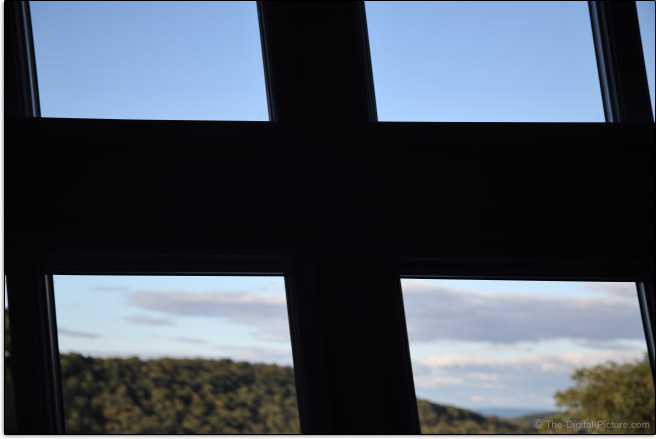
Other downsides of an electronic shutter are primarily related to the current-technology line-by-line reading of the imaging sensor data. Fast side-to-side subject or camera movement will result in an angular-shifted image with vertically straight lines becoming noticeably slanted (with the camera in horizontal orientation). It is not hard to create an example showing this effect. In the example below, the center window lines should be close to vertical.
The horizontal lines, running in the direction I was panning the camera, remain horizontal, but the vertical lines are angled, revealing the line-by-line reading of the sensor.
Understand that the traditional second curtain of a mechanical shutter chasing the first curtain can produce the same effect. However, the difference between mechanical shutter (with electronic first curtain shutter) and electronic shutter performance in this regard has historically been quite big and that is again what I see with the EOS R.
I did not encounter the issue with the R, but certain light pulsing can influence image results, potentially showing banding.
As discussed, with silent shutter enabled, this camera does not make any sound while capturing images. Complete silence is a hard sound to share on a website, so I'll trust that you can understand this camera's ability to be stealthy in that respect. Disable silent shutter with the camera in the default electronic first curtain shutter mode and I can create the shutter sound audio clips. With no mirror locking up, this camera is still a quiet one.
Τα παραπάνω τα βρηκα στο review :
https://www.the-digital-picture.com/Reviews/Canon-EOS-R.aspx