Ευρωπαϊκό Σινεμά και όχι μόνο

..

Its enticing mind-blowing sci-film theme pre-dates The Matrix by 26 years (and I found it more intellectually stimulating) and anticipates David Cronenberg's eXistenZ (1999)). For the then 27-year-old Fassbinder, it was the rare time he had a big budget to work with and shows how his artistic integrity stays intact as he makes a stunningly beautiful visual film (with the corporate setting blandly filled with plastic furniture, many TV monitors for spying, lots of cold chrome surroundings and intrusive glass structured offices that don't allow for privacy) that subversively attacks the establishment for their underhanded power grab and excessive greed. This is Fassbinder at the top of his game.
 
..

β€œSeeing a Fassbinder retrospective is better than drugs, liquor and sex put together” – John Waters

rp77a94J13Y9gB1nMxqiZ85R5UCaSb_large.jpg


Οτι δεν μπόρεσε να κάνει σε όλη την καριέρα του ο αγαπημένος Kaurismaki, ο υπερπαραγωγικός και αντισυμβατικός Fassbinder το πέτυχε με μεγάλη ευκολια σε γυρίσματα 10 ημερών και το πολύ 3 λήψεις.

Εδω εχουμε ενα μεγάλο αριστούργημα, όχι απο αυτά τα αποστειρωμένα που δημιουργούν οι τελειομανείς σκηνοθέτες οπου σκέφτονται για δεκαετίες ενα θέμα...

εδω εχουμε ελλατώματα οπου όχι μόνο δεν ενοχλούν, αλλα κάνουν αυτο το αριστούργημα ακόμα πιο ανθρώπινο.
αν αγαπήσουμε τα ελλατώματα, μόνο τότε η αγάπη μπορεί να αποκτήσει την ολότητα.

εχουμε ολίκη εκφραστικότητα πλάνων, μέσα απο τις συνθέσεις, τα χρώματα, τις σιωπές, τα καδραρίσματα, τον αργό ρυθμό, το κενό (απουσία ανθρώπων, στην ταινία εμφανίζονται μόνο οσοι χρειάζονται) την υπέροχη μουσική..

όλη αυτή η θεατρικότητα και το μελό που διαδραματίζεται, θα με απωθούσε.
όχι ομως στην περίπτωση του Fassbinder οπου παντρεύει το κιτς με την καλαισθησια, το μελόδραμα με μια αφαίρεση στύλ Bresson.
οπου οι αντιθέσεις, οι αμφισημίες και τα διπολα που δημιουργεί ειναι αριστοτεχνικά δοσμένα δίνωντας ενα φιλοσοφικό πεδίο για τον ρατισμό, την μοναξία, την ανάγκη για αγάπη, την εκμετάλλευση συναισθημάτων οπως ο ίδιος αναφέρει οτι ειναι το μόνιμο θέμα του.

β€œEvery decent director has only one subject, and finally only makes the same film over and over again. My subject is the exploitability of feelings, whoever might be the one exploiting them. It never ends. It’s a permanent theme. Whether the state exploits patriotism, or whether in a couple’s relationship, one partner destroys the other.”

ο μαθητής Fassbinder, ξεπερνάει τον δάσκαλο Douglas Sirk και ειδικότερα το εξαιρετικό "All That Heaven Allows"
η σκηνή με την τηλεόραση που Fassbinder, ξεκινάει απο εκεί που ο Sirk την άφησε..
απο σύμβολο μεσήλικης συντροφίας ως σύγχρονη σκλαβιά, σε ενδοοικογενειακή βια και φόβο για την απειλή της κυριαρχίας των παιδιων, πάνω στην ευτυχία της μητέρα.

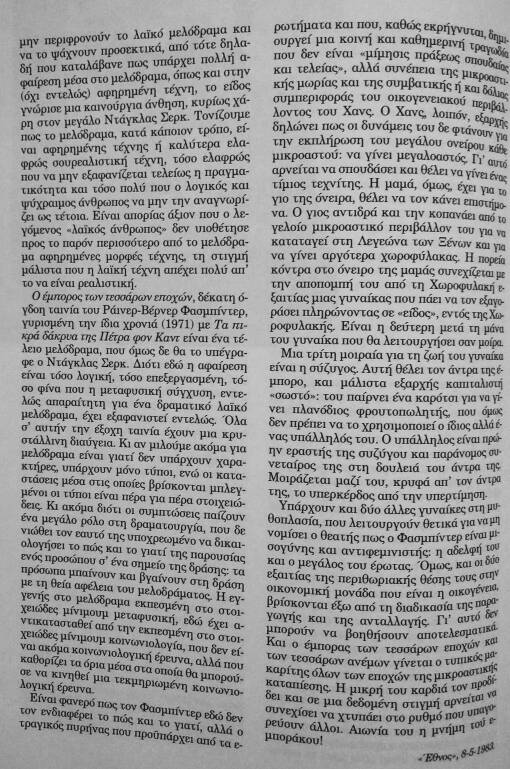
Ο κ. Ραφαηλίδης δεν μπόρεσε να δεί το μεγαλείο της ταινίας αυτης, ίσως όμως γιατί το κείμενο του ηταν σε νεαρή ηλικία και η οξυδερκής πένα του δεν είχε ακόμα γαλουχηθεί.

Ενα εξαιρετικό κείμενο/ανάλυση εδώ

Ali: Fear Eats the Soul: One Love, Two Oppressions


To view this content we will need your consent to set third party cookies.
For more detailed information, see our cookies page.


10/10
 
Last edited:
αν τυχει να την δείτε παρατηρήστε τα αριστουργηματικά mise en scene και τους πίνακες και πώς λειτουργούν σε κάθε σκηνή.
την Elli και τον πίνακα που έχει απο πίσω της μόλις μπάινει στο μπαρ, στην κουζίνα της ο πίνακας με τα φουρτουνιασμένα κύματα, το άλογο που καλπάζει,
την εκπληκτική σκηνή στο εστιατόριο και τον κοινωνικό αποκλεισμό, μοναξία, απόγνωση στην σκηνή με τις άδειες κίτρινες καρέκλες και την γεωμετρία που δημιουργούν.

To view this content we will need your consent to set third party cookies.
For more detailed information, see our cookies page.
 
To view this content we will need your consent to set third party cookies.
For more detailed information, see our cookies page.

To view this content we will need your consent to set third party cookies.
For more detailed information, see our cookies page.

η ατέλεια, της κωμικής εισόδου, στο πως μπαίνει ο Αli στην παραπάνω σκηνή, ειναι αναμφισβήτητα εμφανή.
Αλι, δεύρω έξω..

ομως η σημειολογία και το όλο mise en scene εχει πολύ πιο δυνατους απόηχους απο την αρχική του μεγάλου Sirk.
 
..

ενα πολύ ενδιαφέρον άρθρο για

Criticism vs. Reviewing

What hundreds and hundreds of sites on the web provide are reviews. The reviewers talk about their experience of the film. They say little about the film as such, only about their feelings. They say things like, So-and-so gave a great performance or The cinematography was brilliant. I can’t translate that to anything about the film, only something about the way this person felt about the film. Evidently, the idea behind reviewing is that if the reviewer had a certain experience, then you will have the same experience. That is patently false. It is also not film criticism.

Agee's reviews In my own mind I draw a sharp distinction between film reviewing and film criticism. I used to review films for WGBH-TV in Boston, long, long ago. The people who wrote in told me in no uncertain terms what a film reviewer is supposed to do. A film reviewer is supposed to tell you whether or not you want to see the film in question. Anything else is unimportant.

Reviewers may retell plots. They may make plus and minus statements about acting with (usually) no details. Manohla Dargis of The New York Times recently described writing about a film when you’ve seen it only once. “The easy stuff is usually the story . . . and characters . . . . The tricky part, when I get to scribbling, is everything else . . . . Was the lighting soft or hard, the editing fast or slow, the camera shaky or smooth, the acting broad or not?”

Ebert's reviewsBut most of all reviewers pronounce movies good or bad. Thumbs up, thumbs down. One star or four stars. In my own internet browsings, I am astonished at the number of people who set up shop as movie reviewers and choose to pass judgments and assume their judgments ought to define the way others feel about a movie.

Film criticism is an altogether different breed of cat (although a few reviewers, like James Agee or Roger Ebert, straddle the distinction). Film critics see films more than once. A good critic will point out a pattern in the action or details of shots or something special about the camera work. A critic studies a film in detail, to see it as a work of art. The critic doesn’t just look at broad categories like “lighting” or “editing.” Knight's criticismCritics don’t concern themselves much with evaluation or recommendations. Some like to interpret films, to get at the "meaning" of the film (though I find that a confused concept). Some address film techniques and styles in considerable depth and sophistication. Some develop “theory.” You might take a look at the “senses of cinema” site for various types of good writing about film.

The film critics I respect most try to enhance their readers’ experience of the film by pointing out things of interest. That is what I try to do on this film site, A Sharper Focus. The name says it all. You will find far fewer films here than on reviewing sites, because you really have to work at serious criticism to get a sharper focus.

Sarris's criticism Behind the distinction between reviewers and critics, though, lies another, deeper issue. Are movies just entertainment or are they really an art form? It wasn’t until the late 1950s and early 1960s that people began to take movies seriously as art. Although there had been serious books about movies since Hugo Munsterberg’s The Photoplay in 1916, in the ‛50s more and more books like Arthur Knight’s The Liveliest Art (1957) made the case for Americans that had already been made by the Cahiers du Cinéma critics in France.

In the ‛60s and ‛70s films appeared on the market that clearly demanded that they be considered works of art. The Seventh Seal and La Dolce Vita drew a lot of puzzled commentary from newspaper reviewers, as did other films from Bergman, Fellini, Antonioni, Visconti, Godard, Resnais, and many another. And “film” (as opposed to “movies”) became an academic specialty. At the same time, in 1959, a Holland's criticismhandful of professors (including me) led by Robert Gessner of N.Y.U. created what was originally called the Society of Cinematologists. Today, its successor, the Society for Cinema and Media Studies, has hundreds of members and a huge annual conference. Film is big on campus, perhaps because students think it’s easier to see a movie than to read a book. Oh well.

As long as you think films are just entertainment--go to the theater, enjoy some laughs or thrills, go home and forget about it--then you want reviewers to tell you whether or not you’re likely to have a good time. Film reviews have a simple argument. The reviewer says I did (or I didn’t) enjoy this, and therefore you probably will too. It is, of course, false. We are all individuals. Just as we have unique senses of humor, so our likes and dislikes in entertainments (or works of arts) vary with our unique personalities.

So I really don’t care if Manohla Dargis or A. O. Scott or Anthony Lane had a good time at this movie. If I want to know whether I am likely to enjoy a movie or not, I go to the numbers on IMDb.com or RottenTomatoes.com, arrived at by tallying the likes and dislikes of thousands of moviegoers. They’re much more likely, to predict my reaction than a single reviewer’s take on a film. See my blog on this idea.

Are films entertainment or art, then? Wrong question! It isn't that this or that film is art or entertainment. It’s how you choose to look at a particular film. Are you treating it as simply a two hours’ pastime? Or are you trying to think about it seriously as you would a work of art?

Film reviewers, by and large, treat films as entertainment, and that’s what their readers want. Film critics, as opposed to reviewers, treat films as works of art, write about them as such, and encourage their readers to see films as art. That’s what I do on A Sharper Focus. I hope you will join me.
 
.
Φεστιιβαλ ισπανοφωνου κινηματογραφου
δεν τις μπορω αυτες τις ταινιες αλλα εκανα μια προσπαθεια
στον συμπαθεστατο κινηματογραφο Ελληνις

ΟΙ ΜΑΣΚΕς ΤΗς ΑΒΑΝΑΣ
παντελως αδιαφορο με την παρουσια του σκηνοθετη που ηταν σαν την ταινια του

μηπως μπορει καποιος να μου πει γιατι αυτες οι ισπανοφωνες ταινιες εχουν αυτη την χλωμαδα στη φωτογραφια τους
 
Σε αλλους δεν αρεσει η χλωμαδα της φωτογραφιας των Ισπανικων ταινιων (αλλα δεν εχουν κανενα προβλημα με την ψυχρη φωτογραφια των σκανδιναβικων ας πουμε), σε αλλους δεν αρεσουν τα οριτζιναλ χρωματα της Οδυσσειας και προτιμουν τα αλλαγμενα/"αποκατεστημενα".
Φανταζομαι οτι αντιστοιχα καποιοι θα ηθελαν και τις εναστρες νυχτες του Βαν Γκογκ σε λιγο πιο ζεστα χρωματα, ή τα ηλιοτροπια σε λιγο πιο ψυχρα.

Αλλα επειδη οι Ισπανοι δεν εχουν τη φημη ουτε ενος Κιουμπρικ ουτε ενος Βαν Γκογκ ειναι πιο ευκολο να τους κραζουμε.
Ετσι δεν ειναι?
Δε μας τα λες καλα δασκαλε.
Καθολου καλα...
 
Δυστυχώς οι Ισπανοί, όπως και οι Γάλλοι, έχουν αφοσιωθεί σε μια τηλεοπτική και σεναριακή αισθητική οπου εξυπηρετεί περισσότερο την επιβίωση τους, ως επαγγελματίες, παρά ως ανιδιοτελής καλλιτέχνες. Και δεν μπορεί κανένας να τους το στερήσει αυτο το δικαίωμα. Αντιθέτως, ειναι ευθυνη του θεατή, να αναζητήσει την καλλιτεχνική ανιδιοτέλεια ή το ευχάριστο, διασκεδαστικό δίωρο.

For professional arts criticism to survive the challenges presented by the technology-driven democratization of media platforms, it’s essential that critics leave behind the role of "arbiter of taste" or "hit-maker," and instead serve as engaged, accessible writers, whose work helps audiences navigate the intersection of art, culture, politics and economics.

What most critics at newspapers and magazines produce are reviews: thumbs-up, thumbs-down consumer advice on whether a book, movie, exhibition or whatever else is worth the investment of time and money. But blogs, Twitter, Yelp and a host of other technologies let anyone share their personal reviews. Even if we believe that professional critics are more qualified to pass judgment on a work’s excellence, readers who are just looking for entertainment advice will turn to their peers.

And herein lies the twist: As professional critics continue to play the "arbiter of taste" card, they’re failing both the readers most interested in their beats, who don’t get much from reviews written to attract casual consumers, and the artists they cover, most of whom are desperate for deeper engagement.

Reviewing serves its purposes. But it shouldn’t be mistaken for criticism, thoughtful work that explores cultural endeavors and grapples with history, trends, ideas, formal developments in the arts and the relationship of the arts to the broader culture. If professional critics really are the experts they’re supposed to be, then surely they have something more to offer on this front than advice on how best to spend one's Friday night.

The arts are also transforming in response to technological and social change. We need new criticism for new forms. Our focus at Culturebot, for instance, is contemporary performance, live art that doesn’t comfortably fit under traditional labels like dance, theater or visual art because it incorporates all three, often using new technologies that open up new avenues for exploration.

As the arts evolve, we must develop new frameworks for real criticism that reflect this interdisciplinary, hyperlinked, hybrid world. The need for serious criticism is greater than ever, but all we seem to get β€” whether from professionals or amateurs β€” is more reviews and opinions.

Don’t Confuse Reviews with True Criticism
 
Reviews vs Film Criticism
While the terms "review" and "criticism" are often used interchangeably, there are differences between them. Note how motion pictures are often referred to as "films" when discussing criticism, and "movies" when discussing reviews.

Film criticism is the study, interpretation, and evaluation of a film and its place in cinema history. Film criticism usually offers interpretation of its meaning, analysis of its structure and style, judgement of its worth by comparison with other films, and an estimation of its likely effect on viewers. Film theory (e.g. feminist, postmodernist, etc.) often informs the critical analysis of a film. Criticism may examine a particular film, or may look at a group of films in the same genre, or a director's or actor's body of work.

Film criticism differs from movie reviews in several ways: it entails both analysis and judgement; it may be published many years after a film is released; it is usually longer and more complex than a movie review. A movie review documents the critical reception of a film at its time of theatrical or dvd release. It is more "consumer-oriented," placing more emphasis on recommendation than analysis.

Reviews of feature films or mainstream films may be found in online databases, newspapers, and general interest magazines (e.g. New York Times, Village Voice, Cineaste).

In-depth criticism and analyses of some feature films or mainstream films, foreign films, independent films, documentaries, etc. may be found in more scholarly or academic publications (e.g. Film Quarterly, Cinema Journal, Film International).

Με την ίδια έννοια, (έστω και αν και σινεμά και κινηματογράφος σημαίνουν το ίδιο πράγμα)
προσωπικά ξεχωρίζω το "σινεμά" (ξενόγλωσσο) που δεν μας λέει εννοιολογικά τίποτα συγκεκριμένα.
απο το "κινηματογράφος" το οποιο ειναι η καταγραφή της κίνησης ή γραφή μέ κίνηση.

Θα σας ζητηθεί ενα μικρό δείγμα δουλειάς
οι εγγραφές ξεκινάνε απο σεπτέμβιο.
:p
 
..

To view this content we will need your consent to set third party cookies.
For more detailed information, see our cookies page.

The Bitter Tears of Petra von Kant
8+/10

To view this content we will need your consent to set third party cookies.
For more detailed information, see our cookies page.

THE MERCHANT OF FOUR SEASONS
9/10


4ddc6e2c5d09588b8a15767b3fa8d9c5.jpg
1a8fd0f313239744f898a21ee35c38c3.jpg
6c8fb50481cf440ecd4131a99670e809.jpg


337d760255f7dab9e1524d4406f19073.jpg
 
Last edited:
Μας αρέσουν τα διαλείμματα και οι "ενοχλήσεις"

Τιμή μας να "ενοχλείτε" ..

Αλλά ρε Στελλαρα σου αρέσουν τα γατάκια...

μας αρέσουν οι αγριόγατες που τελικά είναι πιο ευαίσθητες, ευθραυστες και ανεπιτήδευτες από τα γατάκια..

https://youtu.be/UOJTrPI1hY8

Beattles ή Rolling stones
Μερεντα ή Nutella
Τσάι ή καφές
Μουστάρδα ή κέτσαπ

 
.
αγριογατα το Τζενακι ?
ισως λιγο στις ταινιες ...

Γατακι η Αλικη ?
ναι στις ταινιες

αλλα μονο εκει ....

μηπως και η Μαλβινα γατακι ?
με τοσες αντιπαθειες?

για τον Σταθη Ψαλτη δεν εχω αποψη γιατι δεν μπορω να τον βλεπω
 
Re: Απάντηση: Ευρωπαϊκό Σινεμά και όχι μόνο

.
αγριογατα το Τζενακι ?
ισως λιγο στις ταινιες ...

Γατακι η Αλικη ?
ναι στις ταινιες

αλλα μονο εκει ....

μηπως και η Μαλβινα γατακι ?
με τοσες αντιπαθειες?

για τον Σταθη Ψαλτη δεν εχω αποψη γιατι δεν μπορω να τον βλεπω
Ε καμία δεν γνωρίσαμε προσωπικά.
Μόνο τον μέγα Στάθη.

Η ατίθαση ομορφιά και γοητεία της Τζένης ανυπέρβλητη.
 
..


λέτε και ο Γάλεν να πάθει, ότι έπαθε και ο σοφός Wallace... για τον Godard.
:p

To view this content we will need your consent to set third party cookies.
For more detailed information, see our cookies page.


Λέω να κάνω και ενα αφιέρωμα στον τιτάνα John Ford.
ποια προτέινετε, εκτός απο τα παρακάτω..

The Man Who Shot Liberty Valance (1962)
The Grapes of Wrath (1940)
* The Searchers (1956)
The Quiet Man (1952)
* Stagecoach (1939)
How Green Was My Valley (1941)
My Darling Clementine (1946)
The Informer (1935)
Rio Grande (1950)
How the West Was Won (1962)

* τα έχω δει
 
Εδώ άγγιξες χορδή. Έχω στο αρχείο μου 87 ταινίες του Pappy, τρεις, τέσσερεις βιογραφίες και κάτι λίγα ντοκυμανταίρ. 717 γίγα αν ενδιαφέρεσαι. Άνισος, παλιάνθρωπος, μπεκρής αλλά...
Αν θες γράψε για το sun shines bright ή το How green was my valley
 
.
τι να πει κανεις για το μεγαλειο του J.F !
οι περισσοτεροι σκηνοθετες της κιτρινης φυλης εμπνευστηκαν απο το εργο μου
 
..


λέτε και ο Γάλεν να πάθει, ότι έπαθε και ο σοφός Wallace... για τον Godard.
:p

To view this content we will need your consent to set third party cookies.
For more detailed information, see our cookies page.


Λέω να κάνω και ενα αφιέρωμα στον τιτάνα John Ford.
ποια προτέινετε, εκτός απο τα παρακάτω..

The Man Who Shot Liberty Valance (1962)
The Grapes of Wrath (1940)
* The Searchers (1956)
The Quiet Man (1952)
* Stagecoach (1939)
How Green Was My Valley (1941)
My Darling Clementine (1946)
The Informer (1935)
Rio Grande (1950)
How the West Was Won (1962)

* τα έχω δει

Πρωτίστως το 1ο και το 7ο και τα άλλα μετά.